
Word count and SEO go hand in hand, but there’s no magic number for how long a blog post should be to rank on Google.
Some experts swear by 2,000-word epics, while others say short, snappy posts win the day. So who’s right?
The answer depends on your topic, audience, and what’s already ranking for your target keyword. Write too little, and you risk leaving readers (and search engines) wanting more. Write too much, and you’ll bury your best points under filler words.
In this guide, we’ll explain what Google says about word count, whether it matters for SEO, the minimum word count to target (if you insist on a word count), and how to find the right word count for your topic and keywords. Let’s dive in.
Key Takeaways
- Rank Math recommends a minimum of 600 words for posts and pages
- The maximum word count depends on your topic and search intent
- Use as many words as you need to cover the topic in-depth
- Very short pages risk being treated as thin content because they may not completely answer a query
- Word count is not a direct Google ranking factor, and a shorter page can outrank a longer one if it satisfies the search intent
- Longer content tends to rank well because it is usually more detailed, so length is a result of depth rather than the cause
- Content AI can suggest a target word count, link count, keyword count, heading count, and media count for your content
- Treat any suggested word count as a benchmark, not a target, and never pad content with filler to hit a number
In this article, we’ll cover:
- What Is Word Count in SEO?
- Does Word Count Matter for SEO?
- Is Word Count a Google Ranking Factor?
- Content Length vs. Content Depth
- What Word Count Does Rank Math Recommend?
- How Long Should a Blog Post or Page Be?
- Factors That Determine Blog Post Length
- How to Decide the Right Word Count for a Blog Post
- How Rank Math Analyzes Your Content Length
- Best Practices for Creating Long-Form Content
- Frequently Asked Questions (FAQs)
1 What Is Word Count in SEO?
Word count refers to the total number of words in a page’s main content. That is the visible content on a webpage, including the headings, paragraphs, lists, table text, image captions, and any other written material a reader sees on the page.
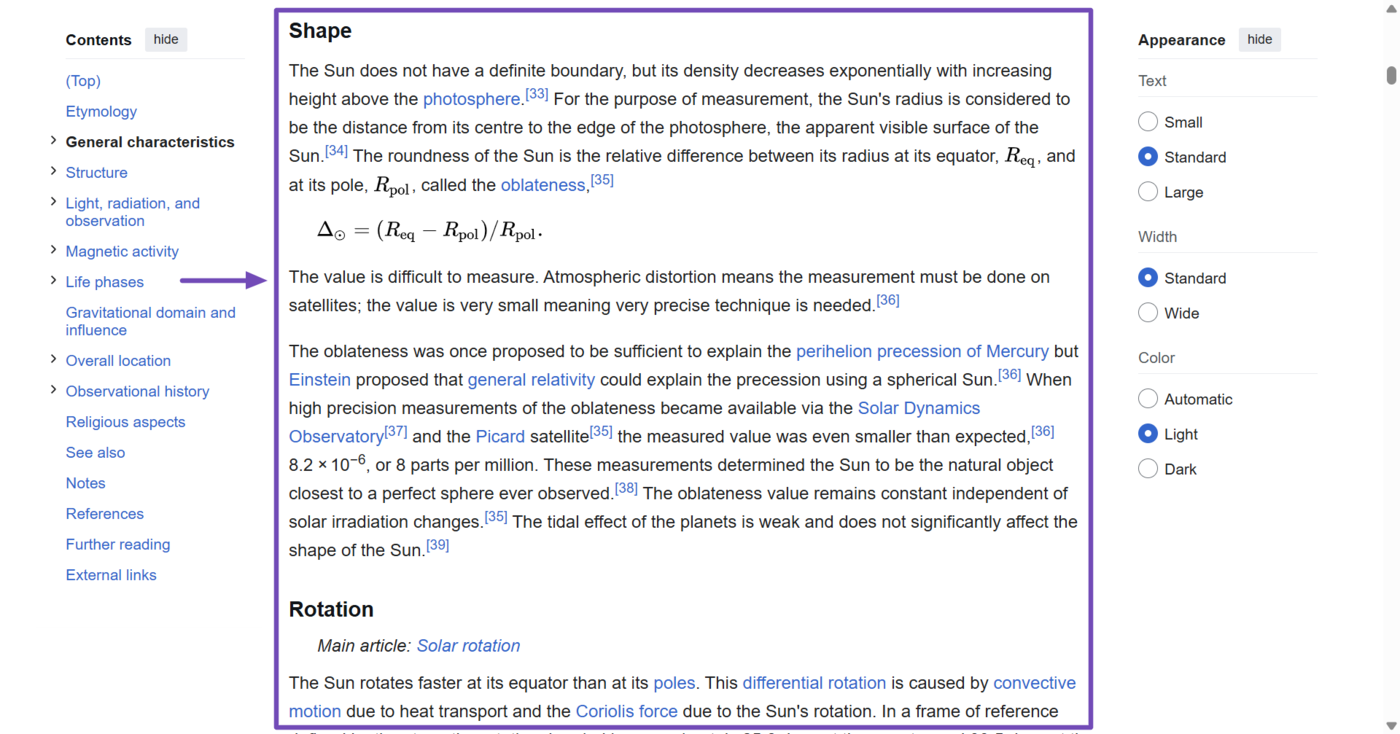
The word count does not include elements that repeat across the site or sit outside the core content, such as navigation menus, page headers and footers, sidebars, cookie notices, ads, and the image alt text.
2 Does Word Count Matter for SEO?
Yes, it does, but not in the way many people think.
Google doesn’t require a specific word count to rank. Google also doesn’t reward articles for having more words, and a shorter article can easily outrank a longer one.
Studies that find a correlation between long content and high rankings are picking up on the fact that helpful content is usually thorough, and thorough content tends to be long. High word count is often a result of depth, not the other way around.
3 Is Word Count a Google Ranking Factor?
No, word count is not a direct ranking factor. Google has repeatedly confirmed that content length has no direct impact on rankings, and it doesn’t have a preferred word count.
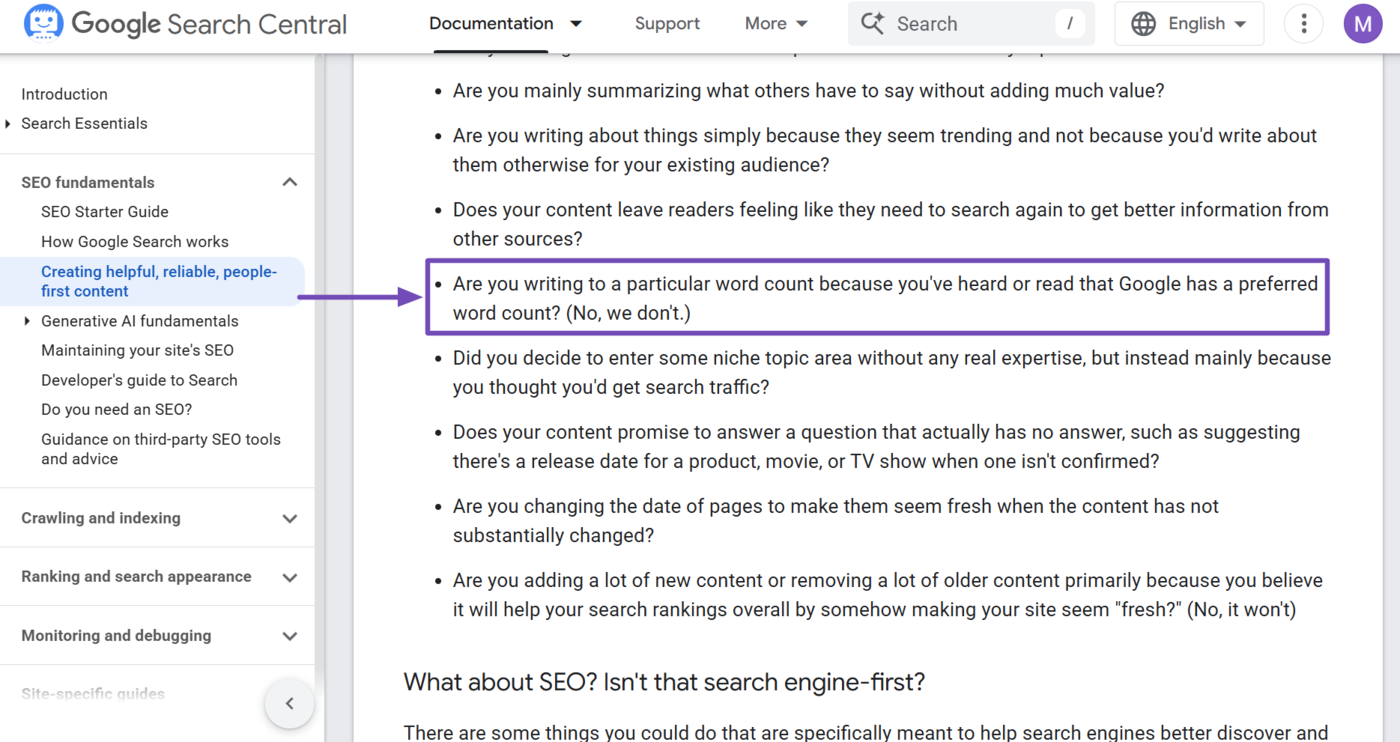
Instead of focusing on the content’s length, Google recommends focusing on depth: create helpful content that fully satisfies the searcher’s intent, and the right word count will follow naturally.
4 Content Length vs. Content Depth
We’ve mentioned content length and depth a few times in this article. Simply put:
- Length is how many words you write (word count)
- Depth is how thoroughly you cover the topic
The two are related but distinct. A deep page answers the main question, covers the relevant subtopics, and anticipates what the reader will ask next.
Simple topics can often reach that depth in 600 to 800 words (or fewer), while complex ones may need 2,000 or more.
When creating content, aim for depth rather than length. Ask whether the reader would leave with everything they came for, not whether you’ve reached a number of words. Length will then follow depth.
5 What Word Count Does Rank Math Recommend?
If you insist on a specific word count, then we recommend writing a minimum of 600 words for your blog posts and pages. Then let the search intent decide how much further you go.
Why do we recommend 600 words?
We recommend a baseline of 600 words because in-depth content is typically a few hundred words long, depending on the topic and search intent. Longer content also gives you a better chance of optimizing for long-tail keywords.
Also, very short pages are more likely to be treated as thin content, especially when they add little value, look spammy or automated, and fail to satisfy the search intent.
To be clear, this doesn’t mean posts that meet that minimum word count are helpful or will rank. It’s just a suggestion for people who insist on meeting a word count.
However, we don’t recommend adding unneeded content unnecessarily just to meet a minimum word count. Always prioritize quality content over quantity.
6 How Long Should a Blog Post or Page Be?
The ideal word count depends on the topic, scope, target audience, and search intent. Google has no official minimum or maximum word count.
That said, detailed content that goes deep into a topic will generally be longer than content that skims the surface.
For example, an article like “10 best cats for kids” will likely pass 600 words, while “how to type the degree symbol” can be well under 200. In contrast, a topic like “how to start a business” can easily require 2,000+ words.
This doesn’t mean you should aim for a specific word count. If you do, make sure every added word is genuinely helpful. Padding a page with fluff to reach a number makes the content harder to read, hurts user experience, and can weaken its rankings.
A good rule of thumb for deciding how in-depth your article should be is to review the top-ranking pages for your target keyword, match their depth, and then cover what they miss. Do that, and you will most likely land on the ideal word count.
7 Factors That Determine Blog Post Length
The ideal blog post length depends on various factors, including:
- Search intent
- Topic complexity
- Target audience
- Competitor’s content
- Content type
7.1 Search Intent
What the searcher wants is the biggest factor in deciding length. Someone searching “how to type the degree symbol” wants a quick, direct answer, so a few short paragraphs will do.
On the other hand, someone searching “how to start a business” expects a thorough guide covering planning, funding, legal setup, and marketing. A guide like that can easily run past 2,000 words.
7.2 Topic Complexity
Broad or technical topics with many subtopics need more words than a narrow or less technical topic.
Content such as “A guide to technical SEO,” for instance, covers related topics like crawling, indexing, site speed, and structured data, which can push the word count into the thousands.
Meanwhile, narrow, simple topics like “What is a meta description” and “How to take a screenshot on a Mac” can be fully answered in a few hundred words.
7.3 Target Audience
The same topic can require different lengths depending on the reader. Beginners usually need more explanation, with definitions of key terms, step-by-step guidance, and examples that show how things work in practice.
Experts, on the other hand, often want a faster, more concise answer that skips the basics and gets to the details.
7.4 Competitor’s Content
The top-ranking pages for your keyword show what depth searchers expect. If they are detailed and comprehensive, you will likely need similar depth to compete. If they are short and direct, a shorter page can compete just as well.
Before you write, review the top results and note their structure, coverage, and clarity. The goal is not to match their word count, but to match or beat their usefulness by covering what they miss.
7.5 Content Type
Different content formats have different norms. A product page often needs only a few hundred words to describe features and build trust, while a landing page should be as long as it takes to remove doubt.
Comparison pages and reviews need more room to weigh options against clear criteria, and in-depth guides usually run longest because they aim to teach a topic from start to finish.
8 How to Decide the Right Word Count for a Blog Post
You can determine the ideal word count for a blog post using Rank Math’s Content AI.
Content AI analyzes the existing search results for your target keyword and recommends a word count based on what’s already ranking. It also suggests how many links, headings, keywords, and media items to include.
Here’s how to use it:
To get started, make sure Rank Math is installed and active on your site.
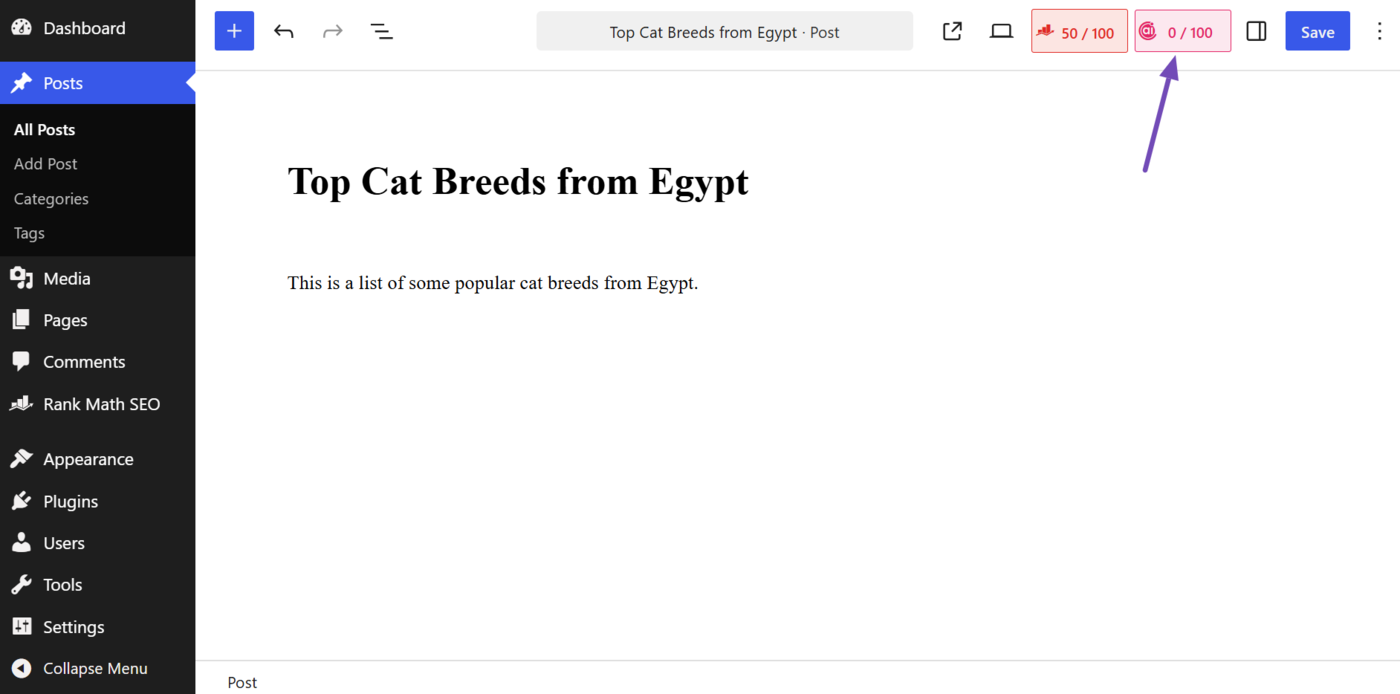
Now, open the post or page you want to optimize. Then, click the Content AI icon in your editor screen.
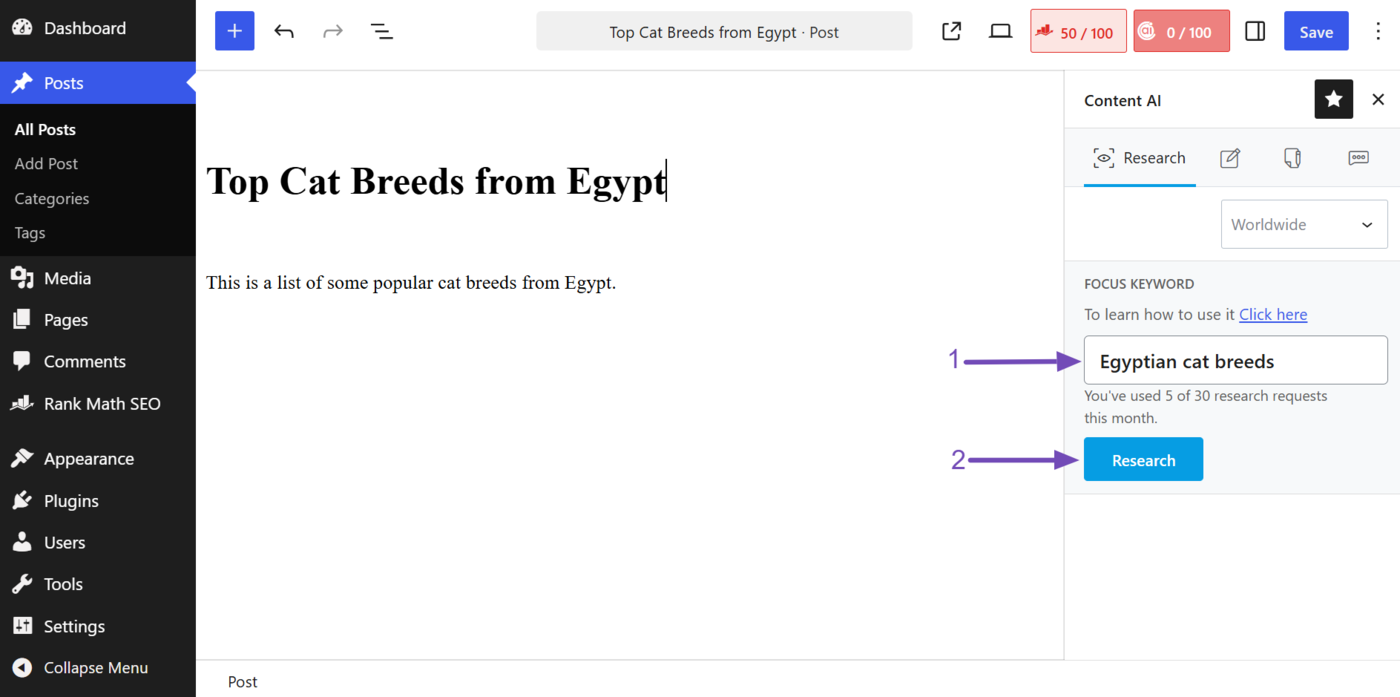
Go to the Focus Keyword field and enter your focus keyword into it. Once done, click Research.
Content AI will research your keyword and return several benchmarks the content should meet, including its word count. Here, it recommends a word count between 752 and 1,128.
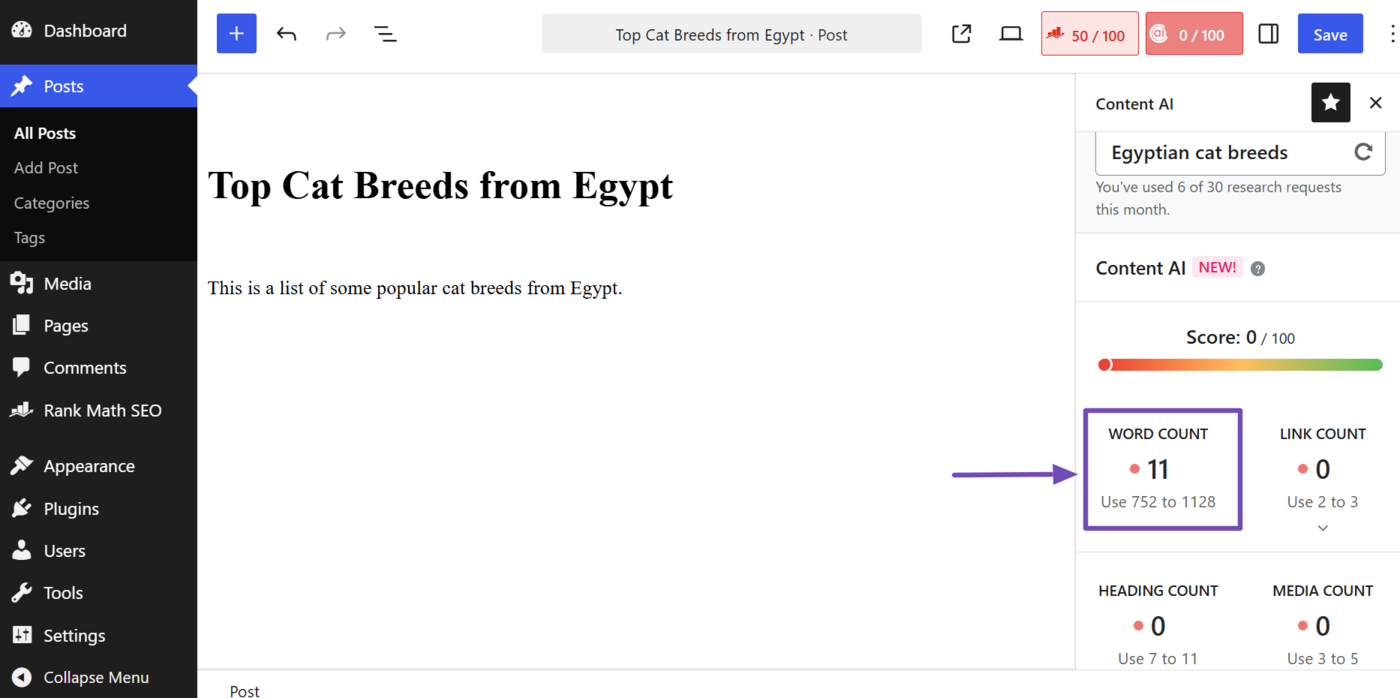
Once you have these benchmarks, you can start creating your content. If you cover the topic in depth, it will land around the recommended word count.
9 How Rank Math Analyzes Your Content Length
Rank Math checks your word count as part of its SEO tests. These tests are criteria Rank Math uses to analyze your content, ensure it is well-optimized, and satisfy the searcher’s intent.
- How to check your word count using Rank Math
- How to fix a low word count using Content AI
9.1 How to Check Your Word Count Using Rank Math
To check how your content did on the content length test, click the Rank Math SEO icon on your editor screen.
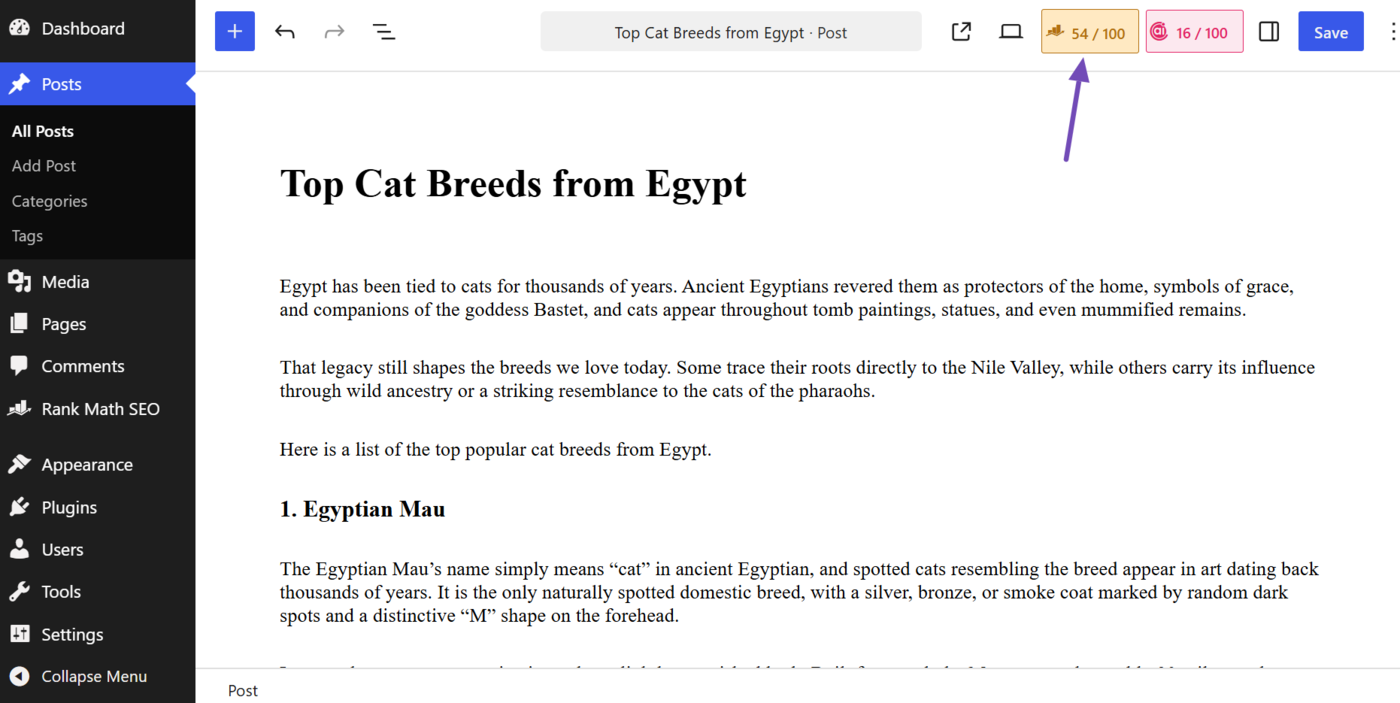
Then scroll to the Basic SEO section. Here, you’ll find your word count and whether it passes the test.
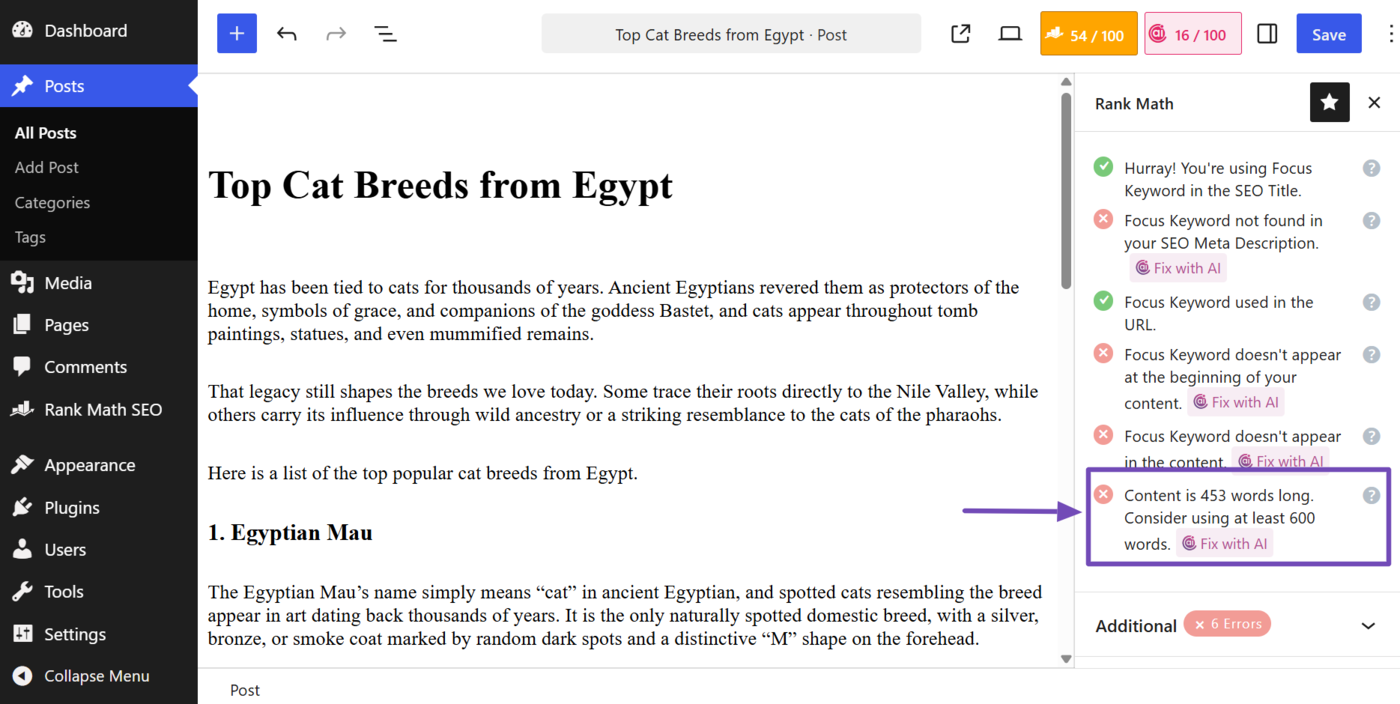
The test is color-coded by word count.
- Red: 0 – 599 words
- Orange: 600 – 1500 words
- Green: 1501 words or more
For most blog posts, make sure your content length is at least orange (600 words or more). If it is below 600, then you can fix it using Content AI.
9.2 How to Fix a Low Word Count Using Content AI
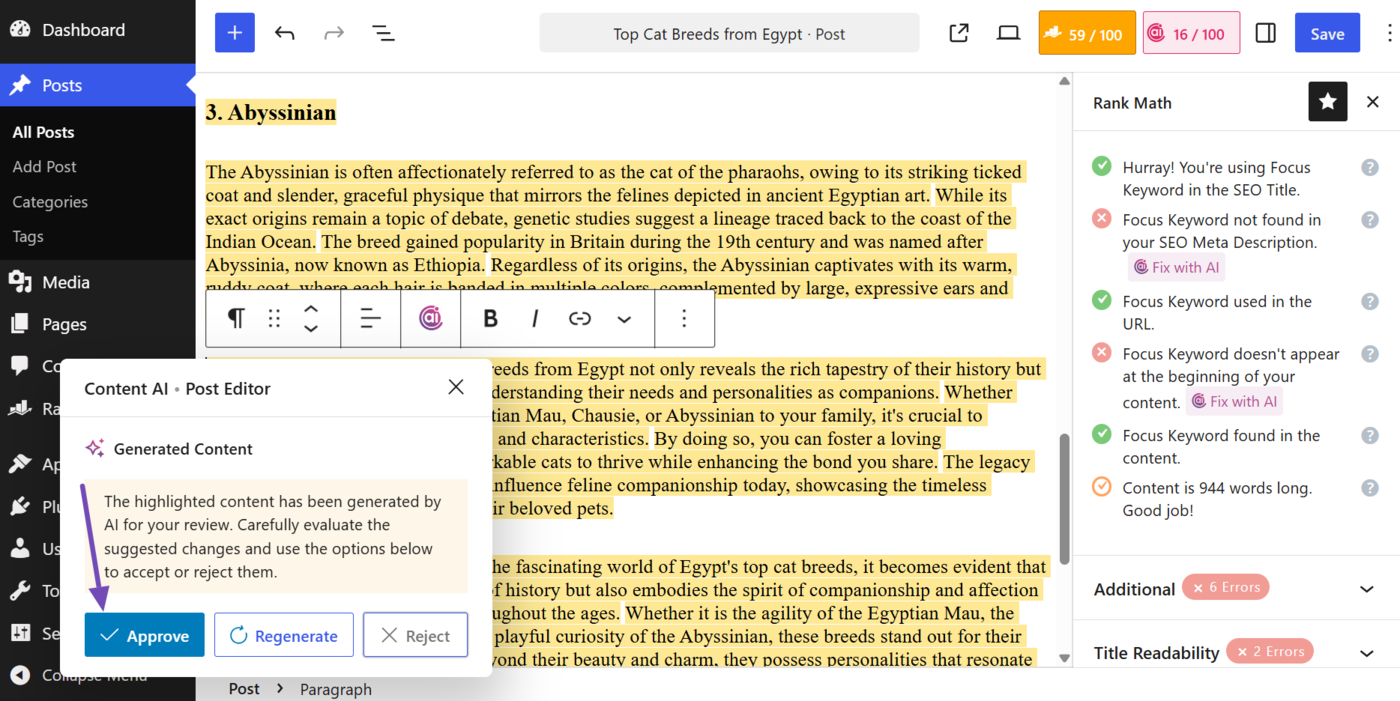
If your word count falls below 600 words, you can quickly generate additional content using Content AI. To get started, click Fix with AI, as shown below.
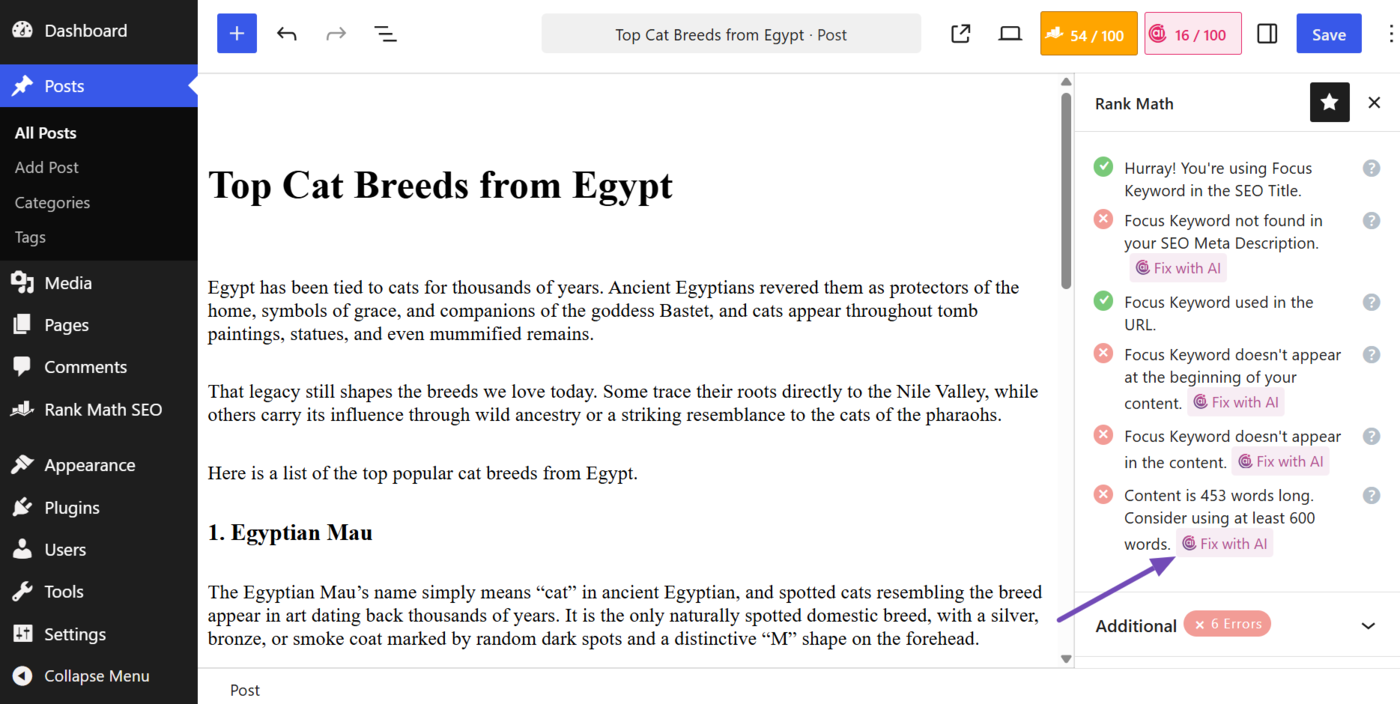
Content AI will generate some additional content. Review it. If you are okay with it, click Approve. You can then edit the new content.
Note: You can also click Regenerate to get new content or click Decline to reject the suggestion.
10 Best Practices for Creating Long-Form Content
Length only helps if people can read it. A long page full of dense paragraphs can put readers off, so follow these best practices to keep your content clear, structured, and easy to follow.
- Keep the vocabulary plain and simple to read
- Keep your sentences and paragraphs short and skimmable
- Ensure the content flows well from one paragraph to the next
- Start with the search intent and let the topic set the length
- Outline before you write so each section has a clear purpose
- Cut filler and repetition, and drop any section that doesn’t help the reader
- Link to related content on your site so readers can explore the topic further
- Add a table of contents with jump links so readers can get to the section they need
- Put the main answer or key takeaways near the top, then go deeper in the main content
- Break your content up with notes, media, and bulleted lists so readers don’t get eye fatigue
11 Frequently Asked Questions (FAQs)
How long should a post be?
Rank Math recommends at least 600 words for regular posts and pages. Beyond that, the right length depends on the topic, search intent, and what already ranks. If 200 or 1,000 words cover it well, you don’t need more.
Does word count affect Google rankings?
Not directly, but it matters. Longer content gives you room to answer questions fully and rank for long-tail keywords, while very short pages risk being seen as thin content.
Does every post need to be over 2,000 words?
No. Longer posts tend to do well, but if you’ve covered the topic completely in fewer words, that is enough.
Is the word count suggested by Content AI mandatory?
No. It’s a benchmark based on the search results for your keyword, not a requirement. Use it to spot gaps, then write what serves the reader.
In conclusion, word count matters for SEO, but never at the expense of quality. Start with the 600-word minimum Rank Math recommends, then let search intent, competition, and the reader’s needs guide how far you go.
If you have any questions about using Rank Math and Content AI, you’re always more than welcome to contact our dedicated support team, who are available 24/7, 365 days a year.